Elizabeth Báthory
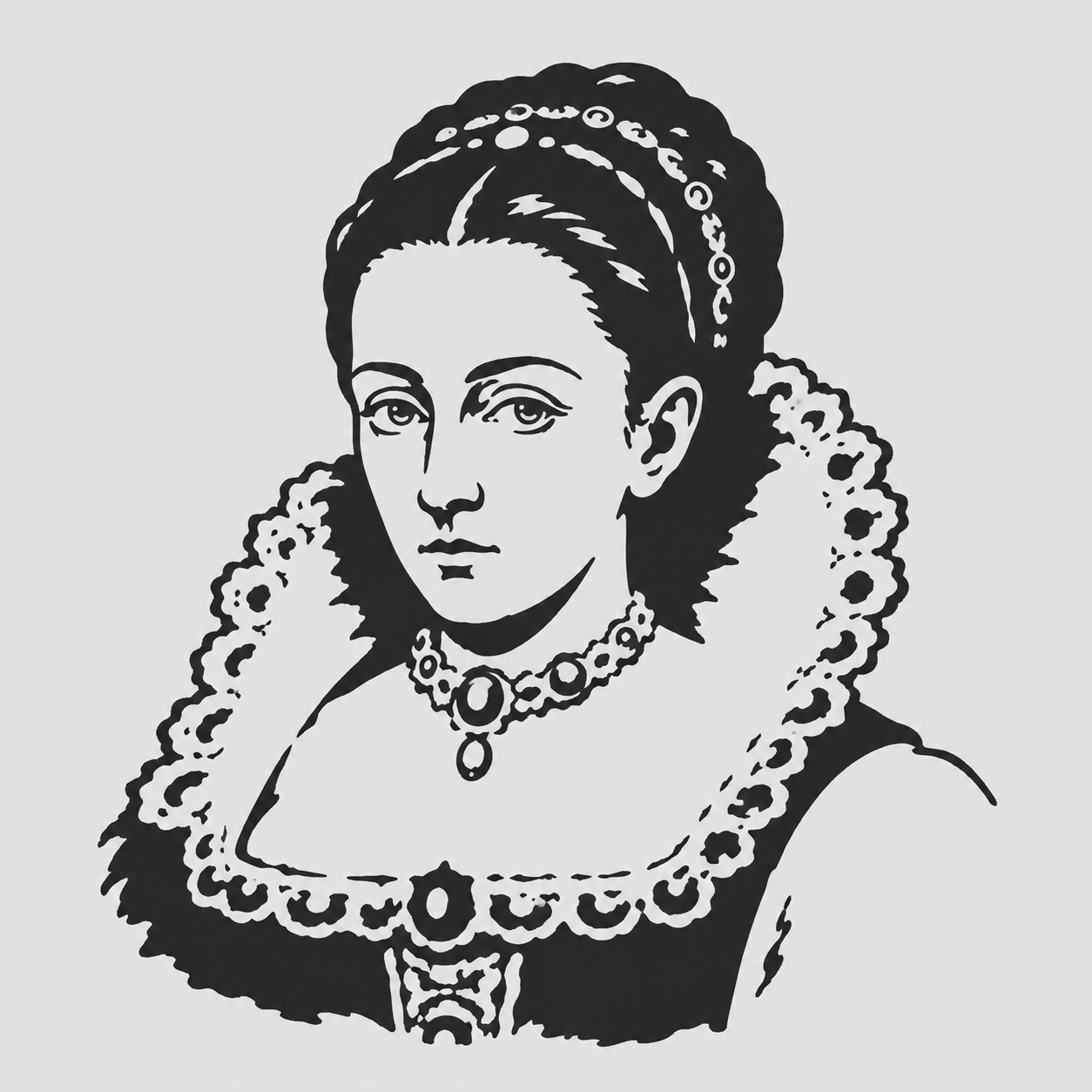
The Hook: The Blood Countess — or the Victim of a Conspiracy?
On a winter night in December 1610, soldiers burst into Castle Čachtice in the Kingdom of Hungary. They found Countess Elizabeth Báthory in her chambers, surrounded by the trappings of wealth and power that had defined her fifty years of life. In the castle’s lower rooms, they discovered something else: girls, dead and dying, bearing marks of torture.
The countess was not arrested. She was not tried. She was walled into a set of rooms in her own castle, with only small slits left for ventilation and the passage of food. There she remained for three and a half years, until she died in her sleep in August 1614.
By the time of her death, Elizabeth Báthory had already become something larger than a woman — she had become a legend. The “Blood Countess.” A noblewoman who bathed in the blood of virgins to preserve her youth. A monster who tortured and killed hundreds of girls. The female Dracula, whose cruelty was so extreme that it transcended history and entered folklore.
But here is what makes Elizabeth Báthory different from other figures in the pantheon of historical villains: we are not sure she did it.
Over three hundred witnesses testified against her. Her own servants confessed under torture and were executed. Physical evidence was described. And yet — she was never formally tried. The king who ordered her investigation owed her money, which was cancelled upon her arrest. Her family was Protestant in a Catholic empire, wealthy in a kingdom where the crown was desperate for funds, and politically connected to rivals of the Habsburg throne.
Was Elizabeth Báthory one of history’s most prolific serial killers? Or was she a powerful woman destroyed by a conspiracy of men who wanted her land, her money, and the neutralization of her family’s political threat?
The answer, four centuries later, remains as dark and contested as the castle rooms where she spent her final years.
Early Life & Formation
Elizabeth Báthory was born on August 7, 1560, at the family estate in Nyírbátor, in what was then Royal Hungary. She was not merely noble — she was aristocracy of the highest order. Her father, Baron George VI Báthory, belonged to the Ecsed branch of the House of Báthory, one of the most powerful families in Eastern Europe. Her mother, Baroness Anna Báthory of Somlyó, came from the other branch of the same family. Through her mother, Elizabeth was the niece of Stephen Báthory, Prince of Transylvania, who would become King of Poland and Grand Duke of Lithuania.
The Báthorys were a family of warriors, rulers, and religious reformers. They were also Calvinist Protestants in a region where religious identity was increasingly a matter of political life and death.
Elizabeth spent her childhood at Ecsed Castle, receiving an education that was exceptional for a noblewoman of her era. She learned Latin, German, Hungarian, and Greek. She was raised in the Calvinist faith, in a household where learning and piety were expected of even the highest-born women.
But her childhood was also marked by illness. She suffered from seizures — what was then called “falling sickness,” now understood as likely epilepsy. In the medical thinking of the time, epilepsy was treated with blood: the blood of a non-sufferer rubbed on the lips, or mixed with a piece of skull and consumed. Whether these childhood treatments influenced her later reputation is impossible to know, but the association between Elizabeth and blood would prove enduring.
There is a disputed story that at age thirteen, before her marriage, Elizabeth gave birth to a child fathered by a peasant boy. The infant was allegedly given to a local woman and taken to Wallachia. The evidence for this comes only from peasant rumors recorded long after her death, and most historians treat it as unreliable. But if true, it suggests a young woman whose body and choices were already subject to the harsh moral codes of her class — and perhaps a resentment that would fester.
The Rise: Marriage, Power, and the Long War
In 1575, at age fifteen, Elizabeth married Count Ferenc Nádasdy, a union arranged between two of Hungary’s great families. The wedding took place at the palace of Varannó, and it combined vast landholdings in both Transylvania and the Kingdom of Hungary. Nádasdy’s wedding gift to his bride was the household at Castle Čachtice, a fortress in the Little Carpathians that would become synonymous with her name.
The marriage was, by the standards of aristocratic unions, apparently companionable. It lasted twenty-nine years and produced at least five children who survived to adulthood: Anna, Orsolya, Katalin, András, and Pál. Elizabeth’s children were cared for by governesses, as she herself had been — a standard practice among the nobility, but one that meant she was not a hands-on mother.
In 1578, three years into the marriage, Ferenc Nádasdy became chief commander of Hungarian troops in the war against the Ottoman Empire. He would spend much of the next three decades on campaign, leaving Elizabeth to manage the family’s estates, business affairs, and defensive responsibilities. Castle Čachtice lay on the route to Vienna, in a region that had been plundered by Ottoman forces. The threat of attack was constant.
Elizabeth rose to these responsibilities with competence. She managed multiple estates, provided medical care during the Long War (1593–1606), and defended her husband’s lands. She was, by all accounts, an effective administrator and a woman who understood power — how to wield it, how to protect it, and how to expand it.
But the world around her was changing in ways that would threaten everything she possessed. The Habsburg emperors, based in Vienna, were consolidating power over Hungary’s fractious nobility. The religious wars between Catholic and Protestant were intensifying. And Elizabeth’s own family was becoming a political liability.
Her nephew, Prince Gábor Báthory, ruled Transylvania and harbored ambitions for the Hungarian throne — ambitions that put him in direct conflict with the Habsburg King Matthias II. Elizabeth’s vast landholdings included fortresses that could aid a Transylvanian military challenge. Her wealth, which increased dramatically after her husband’s death in 1604, made her one of the richest women in the kingdom — and one of the most vulnerable.
The Work: The Accusations
The first complaints against Elizabeth emerged between 1602 and 1604. A Lutheran minister named István Magyari made public accusations and petitioned the court in Vienna. Nothing came of them immediately — perhaps because Ferenc Nádasdy was still alive, perhaps because the Báthory-Nádasdy alliance was too powerful to challenge openly.
But in 1604, Ferenc died. He was forty-eight, and had been ill for several years with a degenerative condition that caused debilitating pain in his legs. Before dying, he entrusted his heirs and widow to György Thurzó, the Palatine of Hungary — a man who would, six years later, lead the investigation that destroyed Elizabeth.
In 1610, King Matthias II assigned Thurzó to investigate the rumors. Thurzó ordered two notaries, András Keresztúry and Mózes Cziráky, to collect evidence. By October 1610, they had gathered 52 witness statements. By 1611, the number exceeded 300.
The testimony was horrifying. Witnesses described girls with flesh torn from their hands, tendons destroyed, bodies scorched with hot irons, fingers cut off with shears. Some victims were allegedly starved for weeks in the castle dungeons. Others were stripped naked, doused with water, and left to freeze in the winter cold.
Several first-hand witnesses provided detailed accounts. Benedek Deseo, head of staff at Castle Čachtice, testified that Elizabeth stripped a shoemaker’s daughter naked, tortured her with knives and burning candles, and continued until the girl died. He described Elizabeth sticking sewing needles into victims’ arms and cutting her way up their limbs. Gergely Paztory, a court judge, testified about a married woman named Modl whom Elizabeth forced to dress and act like a young girl — and then, when she refused, had her flesh cut out and roasted.
The testimony named victims from both peasant and gentry backgrounds. For years, Elizabeth had allegedly preyed on servant girls whose disappearances would not provoke investigation. But eventually, she began killing daughters of the lesser nobility — girls sent to her castle to learn manners and make connections, who instead became victims.
Four of Elizabeth’s servants were arrested, tortured, and confessed. They were executed — three burned at the stake, one beheaded. Elizabeth herself was never formally tried. Thurzó, perhaps seeking to avoid a public scandal that would disgrace the Báthory name, arranged for her to be walled into rooms in her own castle.
The Climax: Imprisonment and the Question of Guilt
The legal circumstances of Elizabeth’s case were extraordinary. She was a noblewoman accused of crimes against other nobles and commoners alike, in a kingdom where noble privilege normally made such prosecutions unthinkable. She was imprisoned without trial, in a manner that suggests her family and the crown wanted the matter kept quiet.
King Matthias had reasons beyond justice to want her destroyed. He owed Elizabeth a large financial debt, which was cancelled upon her arrest. Her family’s political connections — particularly her nephew’s claim to the Hungarian throne — made her a threat to Habsburg power. Her Protestant faith placed her on the wrong side of the religious divide in a Catholic empire. And her vast wealth, concentrated in land and fortresses, was a prize the crown desperately wanted.
Modern scholars have questioned whether Elizabeth Báthory was guilty at all. The case against her rests on testimony extracted under torture from her servants, witness statements collected by officials who had political motives to destroy her, and physical evidence described but not preserved. She was never allowed to defend herself in court. She was never convicted by any legal process.
The most famous detail of her legend — that she bathed in the blood of virgins to preserve her youth — appears in no contemporary source. It was recorded more than a century after her death, in the writings of historians who were repeating folklore, not fact. Modern historians consider it entirely unreliable.
And yet — the testimony of first-hand witnesses like Deseo and Paztory, who were not tortured and who had no obvious motive to lie, is difficult to dismiss entirely. The physical descriptions of victims are specific and consistent. The scale of the accusations — hundreds of victims over two decades — suggests either a monstrous criminal enterprise or a remarkably successful propaganda campaign.
The truth may lie somewhere between these extremes. Elizabeth Báthory may have been a cruel and violent noblewoman who abused her power over servants and dependents — a common enough phenomenon in an era when aristocrats held near-absolute authority over those beneath them. The accusations against her may have been exaggerated, weaponized, and transformed into a legend that served the political needs of her enemies. The “Blood Countess” who bathed in virgin blood may be pure fiction. But the woman who tortured and killed girls in her castles may be, in some measure, real.
Legacy & Reckoning
Elizabeth Báthory died on August 21, 1614, after three and a half years of imprisonment. She was fifty-four years old. Her body was buried, but her legend was just beginning.
Within decades, stories of her vampiric cruelty had entered Hungarian and Slovak folklore. By the eighteenth century, historians were recording — and embellishing — tales of her blood baths. By the nineteenth century, she had become a figure of Gothic horror, her name invoked alongside those of Vlad the Impaler and other Eastern European monsters.
Some scholars have suggested that Elizabeth Báthory inspired Bram Stoker’s Dracula (1897). There is no direct evidence for this in Stoker’s notes, but the association persists — the “Countess Dracula,” the female vampire, the aristocratic predator who feeds on the blood of the innocent.
In modern popular culture, Elizabeth Báthory has become a blank screen onto which anxieties about female power, aristocratic cruelty, and Eastern European otherness are projected. She appears in films, novels, video games, and heavy metal songs — always as a monster, rarely as a human being.
But the scholarly reassessment that began in the 1980s has complicated this picture. Historians like László Nagy and Irma Szádeczky-Kardoss have argued that Elizabeth was the victim of a politically motivated frame-up, her guilt manufactured by men who wanted her land and her family’s neutralization. The lack of a formal trial, the extraction of confessions under torture, the crown’s financial interest in her conviction — all suggest a case that would not meet modern standards of justice.
What Elizabeth Báthory teaches us, then, is not simply that power corrupts, but that the stories we tell about power are themselves instruments of power. The “Blood Countess” may be a warning about aristocratic cruelty, or she may be a cautionary tale about how easily powerful women can be destroyed by accusation. She may be both.
Four centuries after her death, Elizabeth Báthory remains imprisoned in the castle of her own legend — a figure who can never be fully known, only contested, a mirror in which each age sees its own fears reflected back.
Sources & Further Reading
- Kimberly L. Craft, Infamous Lady: The True Story of Countess Erzsébet Báthory (2009) — A comprehensive biography that examines both the accusations and the political context, arguing for a more nuanced understanding of the case.
- Tony Thorne, Countess Dracula: The Life and Times of Elisabeth Báthory, the Blood Countess (1997) — A popular history that traces the evolution of the Báthory legend from historical figure to folklore to modern myth.
- Michael Farin, Heroine des Grauens: Elisabeth Báthory (1993) — A German-language scholarly work that presents the case for Báthory’s guilt, based on extensive archival research.
- László Nagy, A rossz hírű Báthoryak (1984) — A Hungarian-language study arguing that Báthory was the victim of a Habsburg political conspiracy.
- Wikipedia — “Elizabeth Báthory” — Useful overview with extensive citations to primary and secondary sources. https://en.wikipedia.org/wiki/Elizabeth_B%C3%A1thory
- Čachtice Castle — The ruins of Báthory’s castle are now a historic site in Slovakia, open to visitors. https://www.slovakia.travel/en/cachtice-castle
Written for the Bite-Size Bios project.